
When the News Literacy Project (NLP) released its national study of teens’ views of journalism in November 2025, one figure stood out: 84% described news media negatively, calling it “biased,” “boring” or “bad.”
The report, based on a survey of more than 750 teens ages 13-17, arrived at a time when attacks on the press have become commonplace, and misinformation has proliferated across social platforms.
In an interview with E&P’s Mike Blinder in December, NLP’s senior vice president of research and design, Peter Adams, said the findings were less a shock than a confirmation of what educators, researchers and journalists have been seeing for years.

“I was disheartened and upset,” Adams said. “But I was not surprised.”
Adams said the results should be understood in the context of broader societal distrust in institutions and the strain facing newsrooms themselves.
The study was designed to build on a previous NLP study in 2024 that showed that some 45% of teens thought journalists actually harmed democracy. The new study sought to delve into the question of trust — or its lack — and to better examine how teens understand the field of journalism.

“We asked about their understanding of some of the core ethics of how most newsrooms work. Things like correcting errors, only 23% thought newsrooms do that regularly,” he said. “But more than double that — 49% think journalists always, almost always or often make up details, such as quotes.”
Adams said teens often lump professional reporting, partisan commentary and online misinformation together. “Content about current events is, to them, news. It’s pretty much everything they see online,” he said.
NLP’s report did point to potential solutions.
“One positive finding is that 94% of teens said news or media literacy should be part of their education,” Adams said. “They know they need this training.”

Students who had lessons in media literacy were more likely to seek out news and report higher levels of trust in journalists. But only 39% reported receiving any instruction during the prior school year.
The report offers several recommendations for adults in teens’ lives.
“A big one is to be mindful of the examples and the tenor of the conversations you have about the press,” explained Adams. “Certainly, it's important for teens to look at examples of journalism that fall short of the ideals. But it’s also important for teachers and parents to hold up exemplary reporting, reporting that exposes corruption or exposes injustice, so that they have an accurate picture of the work that the press does.”
NLP offers in-depth training and news literacy resources for teachers to use in their classrooms, including lesson guides and materials for different age groups. It also provides resources and newsletters for parents to help them discuss current events and guide teens in distinguishing between standards-based news and opinion.
Looking for turnkey solutions

Donnell Probst, executive director of the National Association for Media Literacy Education (NAMLE), said the distrust reflected in NLP’s study mirrors broader societal trends.
“I don’t think it’s a youth issue,” Probst said. “I think it’s an issue with the general public that there is a growing distrust in the press. There’s also a growing distrust in expertise.”
Probst said that, in her experience, many teens in the study are likely repeating narratives they hear from parents, caregivers and online communities, rather than forming opinions based on direct experience with journalism.
“If we don’t have personal experience with something, you’re informed by others,” she said. “Is it more a reflection of the family circumstances of these students than them having poor information?”
Probst said, even with that likelihood, media literacy remains essential. “When we understand what the process is and how journalism is created, it’s much easier to understand how to identify good journalism,” she said.
Probst also noted that much of traditional news content is not designed for young audiences. Repackaging conventional reporting for platforms like TikTok without adapting language, context or presentation, she said, often fails to resonate.
Young people, she said, frequently lack the historical and civic context needed to understand news stories, making coverage feel confusing or irrelevant.
“It’s like opening a book to the middle and expecting to understand the information. Youth do not have the context,” explained Probst. “They're still learning about very basic structures in our government, in our press, in foreign policy, etc. So, for them, the news is boring.”
Media literacy is preventative rather than curative, explained Probst, “It is most effective when introduced early, before beliefs harden.”
With that in mind, Probst said NAMLE is working to provide more training for teachers. The nonprofit recently received a major grant from the Mellon Foundation to develop a free, open-access curriculum that allows teachers across subject areas — from math and science to history and English — to integrate media literacy into their classes.
Probst said the initiative is designed to address a key barrier teachers face. “We’re telling teachers, ‘You need to be doing this,’” she said. “And they’re responding, ‘I don’t even understand how this connects to my particular field.’” To address that need, the organization is building a learning management system that walks educators through a curriculum tailored to their teaching area. Probst said they expect to launch a pilot program in 2027.
“It’s a very good preventative measure,” Probst said, but far less effective once beliefs are deeply embedded.
Bringing back student papers


That philosophy — get to them while they are young — aligns with the work of Lara Bergen and Beth Fertig at Press Pass in New York City, an organization that helps public school teachers in middle and high schools set up student news organizations.
Bergen, a former public school teacher with no background in journalism, founded Press Pass after starting a high school newspaper and seeing its impact on students. She explained she was struck by how few public schools, particularly in low-income communities, offered journalism opportunities to their students.
Bergen said she realized just how little she knew about journalism before helping her students set up the paper. “Most teachers don’t have a real understanding of what is involved in making real journalism. I didn’t know about the need for primary sources, libel laws or many of the ethics.”
Bergen said her students were really inspired by producing their own newspaper. “They liked interviewing people and being on a team.”
A 2022 Baruch College survey found that 73% of New York City public schools lacked student newspapers, with access concentrated in private and selective schools. Fertig, the executive director of Press Pass and a former education reporter for WNYC, said the inequity Bergen saw was familiar to her from years of covering New York City schools, “This is always a city of haves and have-nots. It's the perennial problem whenever I covered education,” she said. “The private schools, or those elite public schools, would have a school paper, but no one else.”

Press Pass trains teachers, most of whom lack journalism backgrounds, to launch and sustain student newsrooms. Since incorporating as a nonprofit in 2021, the organization has supported 38 public schools, 90% of which are Title I.
Students learn by reporting on their own communities — interviewing classmates, teachers and administrators about issues that affect daily life.
“We have middle schoolers at a school in Brooklyn who were really interested in why the school construction project was taking so long,” explained Fertig. “They were exploring all different aspects of that, the money, the dust, which was causing the cafeteria to be closed. It gives them something to help their friends learn what’s going on.”
Fertig said that visibility matters. When students see people they know quoted accurately in a publication, they begin to understand sourcing, verification and accountability.
That local experience, she said, helps students grasp why journalism operates differently from influencers or opinionated online content. “They feel a lot more confident when we give them surveys about how to talk to adults, and how to figure out which sources of information are true versus false,” said Fertig.
Press Pass surveyed students participating in school-based journalism programs during the 2024-25 school year. Among respondents, 66% said they knew how to distinguish reliable news from misinformation, up from 33% before joining. The share who said they knew where to find accurate news rose from 30% to 59%.
“We have some schools that are elementary through middle, and some elementary school students also work on the newspaper because the teachers are seeing that the kids really love it,” said Fertig.
The learnings are ones Bergen said the students advance on many levels. “You can’t be on a student newspaper and not become a better writer or not become a better critical thinker,” she said. “There’s no better way to be engaged in your community and to know how your community works.”
Collective answers for collective problems
Local newsrooms and individual journalists have been doing grassroots work to help with media literacy. Peter Adams explained that NLP maintains a robust list of volunteer journalists in communities across the country who are willing to visit classrooms upon invitation from teachers.
The American Press Institute (API) recently announced that its Local News Summit in March will be focused on Youth Trust and Civic Resilience. The conference will highlight programs from local newsrooms that center young people — such as the Baltimore Beat’s youth voter guide and free subscription program for high school students from Lookout Santa Cruz, and graduation-gift subscriptions for The Minnesota Star Tribune — to spark ideas for other publishers.
Those on the ground and in classrooms say NLP’s study reflects the cumulative effect of years of political attacks on the press, the erosion of local news and a school system that has struggled to integrate media literacy in a meaningful, sustained way.
By the time many students reach college, the knowledge gap is wide.

Carla Murphy, an assistant professor of journalism at Rutgers University who teaches reporting and media ethics and studies the field, said journalists can play a role in media literacy, but there are limits to what they can do. “This isn’t something journalists can fix on their own,” she said. “It’s an education issue. It’s a policy issue.”
Murphy said the findings of the NLP study mirror the dynamics she encounters when students arrive in her college classroom. She explained that even journalism majors often arrive in her class without a basic understanding of what journalism is or how it differs from other forms of media.
“They don’t know the difference between a byline, the headline, the deck,” Murphy said. “They don’t know a dateline.”
Murphy teaches introductory reporting, advanced journalism courses and media ethics. The lack of foundational knowledge, she said, is consistent across levels.
“It doesn’t matter whether I’m teaching the entry level or the advanced,” she said. “Most students haven’t seen an actual front page of a newspaper.”
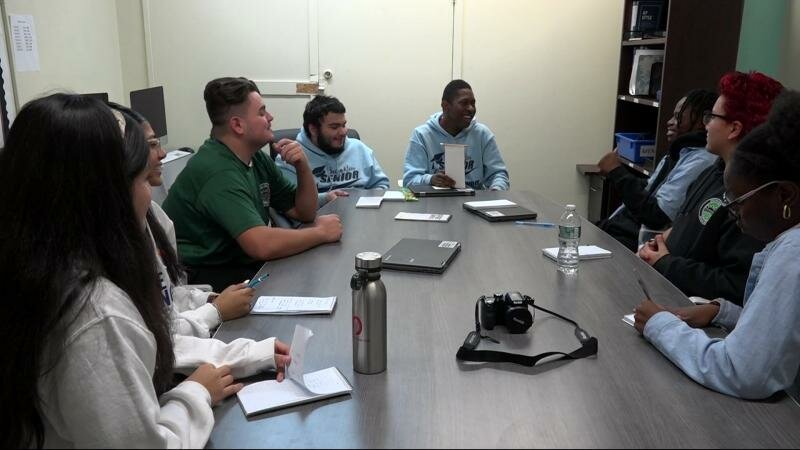
Murphy said she uses NLP’s materials in her class and shared their recent study with her students to engage them in critical thinking about the profession. She also encouraged them to look at their own media consumption, “It was a good way to have them look at what media they are taking in,” she explained.
Murphy said she hears the same critiques from her students — that journalism is biased or boring — including from students who plan to enter the field.
Murphy said sometimes adults think the technological fluency young people have with devices and platforms equates to a sophistication with media. “You can have a facility with the devices and still not know how to find quality information, how to search, where to search, how to evaluate it,” she said.

Murphy said she frequently invites journalists into her classes to help explain how they do their work, but she cautions the idea that journalists and newsrooms can shoulder the full responsibility for fixing the media literacy problem is misguided. “Newsrooms are strained and vulnerable,” she said. Journalists who remain, she added, are often “doing 10 jobs, and you’re underpaid.”
Expecting those same journalists to educate the public about media literacy, she said, is unrealistic. “That’s a mismatch,” Murphy said. “Newsrooms don’t have the capacity to do this job.”
That said, she points out that media literacy is increasingly a business issue for journalism itself. “If your population of potential consumers is media illiterate,” Murphy said, “you’re basically disappearing the industry over time.”
The challenge, she said, is collective.
Murphy called for media literacy to be embedded in general education requirements at universities, community colleges and workforce training programs, rather than siloed within journalism departments. The skills journalists use, she said, are essential for everyone, regardless of profession.
“We’re asking for individualist solutions to collective action problems,” Murphy said. “I think we consistently shrink the actual size of the problem that we're talking about. We’re in the territory of knowledge production and creation — that’s not just down to journalism. But I would love to see newsroom leaders and journalists collectively come together and make a push for the policies we need.”
 Diane Sylvester is an award-winning 30-year multimedia news veteran. She works as a reporter, editor and newsroom strategist. She can be reached at diane.povcreative@gmail.com.





Comments
No comments on this item Please log in to comment by clicking here