
Student journalists play a critical role not just in reporting on their high school or college campuses, but on the broader surrounding communities. From rural towns to cities where professional local newsrooms have been diminished or destroyed, student presses may be one of the few credible sources of information left standing.
According to the Pew Research Center, as of 2023, one-in-10 state capitol reporters were student journalists.
But student press outlets have struggled, like all local news media, just to “keep the lights on,” and they’ve faced some troubling new challenges.
Last November, Sophia Bangura, a student reporter at WUVA News — the student-run independent media organization at the University of Virginia — was fired for “insubordination” after asking some tough questions of the interim university president during an in-person interview, as reported by Catie Ratliff at C-VILLE.com. She was fired by WUVA’s president and editor-in-chief, who is also part of the university’s media relations team.
In 2025, the Department of Education — newly minted under the second Trump Administration — targeted dozens of colleges and universities with investigations into their Diversity, Equity and Inclusion (DEI) programs, according to reporting by The Associated Press’ Collin Binkley. DEI was at the center of a case at the University of Alabama, where two student-run publications were shuttered — Alice, a magazine for undergraduate women, and Nineteen Fifty-Six, a magazine focused on the Black undergraduate community.
Morgan State University in Maryland drew scrutiny for a new campus-wide media policy that restricts how student journalists may approach administrative or faculty sources, or film on campus.
And yet, despite these impediments and what seems to be eroding relationships between schools and student media, student journalists soldier on.
Practicing student journalism in Indiana
For student presses in Indiana, free-press protections were top of mind in 2025.

E&P spoke with Kris Cundiff — a local legal initiative attorney covering Indiana for the Reporters Committee for the Freedom of the Press (RCFP) — about the Indiana Daily Student (IDS). Representing the editors-in-chief, Cundiff sent a letter to Indiana University (IU), objecting to the administration’s firing of IDS’ adviser, Student Media Director Jim Rodenbush, and the university’s mandate that print editions distributed on campus must not contain news, but instead carry promotional content for the university.
While IDS is editorially independent, its home is at IU’s Media School.
“These young journalists are there; they want to do this work. They’re passionate about it. That is important, especially now. I try not to be ‘doom and gloom,’ but it’s a concerning time for people not only working in journalism but those who are considering going into the field,” Cundiff said.
On Oct. 30, 2025, Indiana University reversed course on its mandate. It was the same day Rodenbush filed suit against the university, alleging IU had violated his right to free speech and due process. The university subsequently convened a student media task force, with members of the newsroom, the administration and faculty.
Published by the Purdue Student Publishing Foundation, The Purdue Exponent is a student-run newsroom independent of Purdue University. Since 1889, it published under that name. But in 2025, Purdue University demanded that the paper delete Purdue from its name and relinquish its purdueexponent.org URL.

Olivia Mapes started working for the paper her freshman year and is now in her second semester as editor-in-chief. When she and CEO, Publisher and News Advisor Kyle Charters spoke with E&P in January, she’d just returned to her desk after spending the morning reporting on the local fire station. Her enthusiasm was palpable as she recounted the experience of talking to the firefighters and seeing the inside of their emergency vehicles. When she graduates, Mapes plans to continue working in local news.

Kyle Charters graduated from Purdue University in 2001. As a student, he worked for The Exponent as an assistant sports editor, then as managing editor. It provided him with a solid foundation for his professional career as a sportswriter and radio news director. “But I was excited for this opportunity and excited to be back,” he said.
The university doesn’t have a journalism school, so the students who staff The Exponent are studying other fields. Charters estimated that about 60% of the current staff are STEM majors. “We also have someone who is studying law. We have an engineer — so a wide variety of majors in our newsroom,” he said.
In any given semester, The Exponent employs around 100 students.

The newsroom covers all happenings on campus but also reports on the broader Lafayette and West Lafayette communities. The paper is printed twice a week — down from its previous five-times-a-week print frequency. It is distributed on campus and at 30+ off-campus sites. The Exponent operates its own printing press, and part of its revenues comes from producing commercial jobs.
In solidarity with the student journalists at the Indiana Daily Student, The Exponent’s staff produced a special edition — with the headline “We Student Journalists Must Stand Together” — and distributed it across IU’s campus.
“We had a long-standing distribution and licensing contract with Purdue that was not renewed in 2014. We signed it; Purdue did not. But we had been working under those terms since then. In the summer, Purdue decided it did not want to assist us with the distribution of the paper on campus,” Charters told E&P.

They’ve had to retool their on-campus distribution strategy.
“We’re still getting on campus. We drop off overnight on loading docks or in entrances. About 80-90% of the time, those newspapers are still making it to their racks inside,” Charters said.
E&P sought comment from Purdue University. A spokesperson referred E&P to a June 5, 2025, statement that argues that the student press is a private business, “not a recognized student organization,” and that the university is under no obligation to facilitate distribution.
Regarding the rebranding, in a May 30, 2025, letter to Charters and then Editor-in-Chief Seth Nelson, the university’s legal counsel wrote in part, “The absence of the Purdue name from that masthead is appropriate, for two reasons. First, the Foundation should not associate its own speech with the University. Second, the Foundation has no license to the Purdue name for commercial use. We therefore ask the Foundation to modify its URL to align with The Exponent masthead by removing the Purdue name.”

Asked about recent reporting on the university, Mapes offered some examples.
“We’ve had articles about the impact on Purdue of the Trump Administration’s policies on international students at Purdue. There were visa issues back in January 2025, and I recently wrote an article about applications that were rescinded by Purdue because they’re now limiting which countries they’re allowing for grad school. That was a big deal,” Mapes said.
“One of my other articles was about insurance at Purdue. … The costs had risen so much that professors began considering leaving because of the benefits. They can’t afford the cost of being at Purdue, which is really unfortunate, because a lot of them love Purdue and want to stay.”
The Exponent also published a story the university pitched, about a new marching band director.
“We try to find stories both positive about the community and university, and at times, critical of them,” Charters said. “We don’t like to get beaten by the other media in town, but we strive to be accurate and do a good job.”
Student media as proving grounds
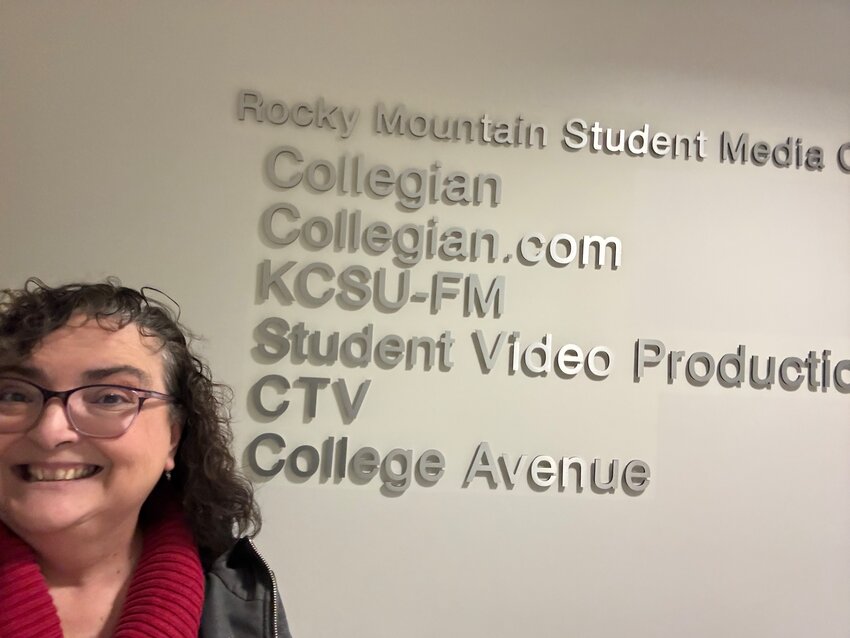
Oftentimes, professional journalists trace their career paths back to their high school or college newspaper, radio station or TV studio. That was the case for Linda Carpio Shapley. She was a communications studies major who needed a part-time job while enrolled at Colorado State University. She applied for a copyediting job at the student newspaper, The Rocky Mountain Collegian.
She recalled the day she realized she was already working as a professional journalist. It was election day. She drove two hours back to her home to vote in the morning — and have pancakes with her parents — before hurrying back to campus to cover the election results that evening.
“I’d had two hours of sleep in a 48-hour period, and I remember thinking, ‘Oh! This is journalism,’” she said. She was promoted from copyeditor to associate editor and served as editor-in-chief her senior year.

“The joke in the office is that we were majoring in The Collegian. But if it hadn’t been for The Collegian, I wouldn’t have found my career,” she said.
Shapley went on to have a remarkable career in journalism, and in a “full-circle moment,” she returned to The Collegian as interim president and CEO of Rocky Mountain Student Media (RMSM), a nonprofit that publishes the paper, a companion website and College Avenue, a quarterly magazine; as well as operating CTV, a TV station; KCSU, the student-run radio station; Tree Stump Films, a documentary arm; and a video-production studio.


Though editorially independent, RMSM receives some funding from the university, because the news organization serves in an educational role, with real-world on-the-job training, Shapley explained. “[Journalism] requires a certain level of grit that, hopefully, student media can help prepare you for,” she said.
Shapley said the challenges she sees ahead are not unlike those every newsroom faces today — meeting audiences where they are; developing compelling digital experiences; innovating; and creating fresh, new products.
When E&P spoke with Shapley, she was preparing for a meeting with school administrators. “We recognize that they have a job to do, and we hope they’ll recognize that we have a job to do — and ultimately, we all want what’s best for our students. That’s our mission,” she said.
Student journalists press on
“2025 appeared to be a very busy year for university administrators who wanted to stifle the student press and make it harder for them to report and reach their audiences,” according to Marie McMullan, student press counsel, campus rights advocacy at FIRE, the Foundation for Individual Rights and Expression.
“Defunding. Obstructing print or distribution. Those are signs of censorship, and there may be more hostility than previously seen toward the student press, and that’s what we’re focused on here at FIRE, with our Student Press Freedom Initiative,” said McMullan.
Part of the initiative is a 24/7 hotline that student journalists can call when they’re facing threats of censorship or have questions about media law.
“It’s obviously a resource that is still needed today, maybe now more than ever,” McMullan said.
From her FIRE vantage point, McMullan sees the big picture for student presses around the country. She listed several examples of campus news being defunded and subjected to what she called “censorship playbooks.”
FIRE and the Society of Professional Journalists (SPJ) co-authored a letter to Morgan State University administrators, pushing back on prohibitive policies on sourcing and filming on campus. “Now, newsgathering with video coverage isn’t allowed there without administrative approval. … FIRE has an entire department dedicated to helping universities create policies that align with free-expression principles and the First Amendment,” McMullan said. “We would love to see them utilize that resource.”
“Student reporters are closest to matters affecting the university. In many ways, they’re best situated to tell the stories that are happening on their campus — as they’re unfolding,” McMullan said. “I think about the Brown University shooting, and it was the student journalists who were live-tweeting what was going on. They were so quick in their reporting. The Harvard Crimson’s reporting about the Epstein files had a major impact. These students are doing work of the same caliber as professional news organizations. Student journalists are journalists at the end of the day.”
 Gretchen A. Peck is a contributing editor to Editor & Publisher. She's reported for E&P since 2010 and welcomes comments at gretchenapeck@gmail.com.





Comments
No comments on this item Please log in to comment by clicking here