
Arguably, television is the mightiest of media. It’s the “window on the world.” It’s where consumer brands become legendary. It reaches almost every U.S. household. And — it’s Americans’ first choice for entertainment and information.
As ubiquitous as television is, there is more evidence that television broadly and local broadcast specifically may be in a similar position to legacy newspapers 10 or more years ago. News organizations’ business model on which they always relied was generating fewer revenues. They were ill-prepared to compete with social media and other digital platforms and technologies and reacted slowly to overcome those challenges (a work still in progress).
Although one-quarter of financial reports is not necessarily indicative of a troubling trend, many of the largest broadcast TV groups and entertainment giants’ Q2 2024 financials were “soft” at best. Total revenues and core ad revenues decreased, despite significant increases in political advertising. Companies with major stakes in cable TV took billions in write-downs. Some local TV stations may be sold. Layoffs continue, often in the thousands. Subsequently, many of these companies have lowered their total revenue and ad revenue forecasts, suggesting the start of a slow downward spiral.
Borrell Associates, led by Gordon Borrell, CEO, is respected for understanding local media and the local advertisers who use it to engage with their target audiences. According to Borrell, local broadcast TV relies on three primary revenue sources: retransmission fees (retrans fees), local broadcast TV advertising and, to a lesser extent, digital advertising.
He thinks the biggest concern for local broadcast TV is retrans fees. “The industry average for retrans fees is approximately 55% of total revenue. Retrans fees increased 28% during the first half of 2024 compared to the same 2023 period. Looking between the quarters, however, retrans fees decreased 3.7 percent from Q1 to Q2 2024. That’s a shocker.”
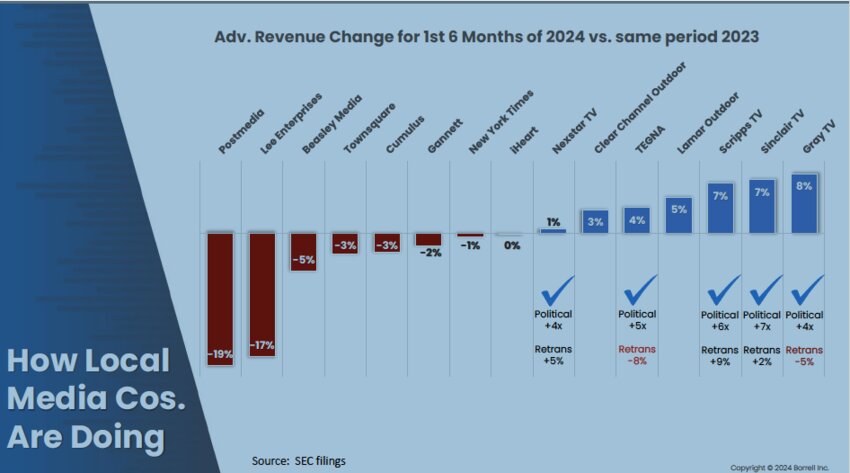
According to Borrell’s data, local broadcast TV advertising accounts for approximately 28% of total revenues, and those core dollars are also declining. Together, retrans fees and core ad revenue are approximately 72% of base revenues. While political advertising continues to bolster local core ad revenues, Borrell doesn’t think political advertising will close the gap, regardless of how much those dollars increase in the future.

Dustin Block, former audience development lead at Graham Media Group, also views retrans fees as the key to understanding how television’s possible decline parallels the newspaper industry.
“I remember working in newspapers and watching classified advertising disappear. For TV, it will be the retrans fees from the cable providers. Those fees helped to prop up the industry and keep it profitable and healthy. Those declining fees, however, will expose the underlying advertising model, which has been flat to shrinking. If local broadcasters must return to advertising to fill the gap, then that will be difficult,” Block said.
Despite loans ' high interest rates, the automotive market is experiencing some positive movement. The BIA Automotive Report forecasts that 2024 local ad spending will increase 2.2% YOY; however, it is 27.2% less than pre-pandemic spending in 2019.
The outlook for local cable TV companies may not be as bleak. Nonetheless, as cable TV cord-cutting continues, subscription revenues will suffer, along with the resulting retrans fees. Borrell says a significant advantage of cable TV is that it is viewed as a utility. Many households use cable companies’ Internet services, and local businesses have relationships with them for either telephone service, Internet access or both.

Joseph Annotti, president and CEO of the Media Financial Management Association, agrees with Borrell’s assessment but has also noticed the changing role of chief financial officers (CFOs) during the TV industry's transition.
“Historically, CFOs focused on controlling costs, managing the money and ensuring profitability. As the industry adjusts to the digital and AI revolutions, the CFO is much more of a strategic planner. The successful ones are breaking down the wall between the expense-control guys and the revenue generators. They need to talk to each other more and understand the future of these revenue streams. Then, they can actively target them and work collaboratively to reinvent the industry,” Annotti said.
Insights from leading advisers and consultants
Highly regarded senior advisers at major consulting firms, such as Grant Thornton Advisors, KPMG and RSM, are leading their media and entertainment clients through the maze of changes these industries are experiencing.

Victor Kao is a risk consulting partner with RSM US LLP and has been an accounting, operations and information technology analyst for over 20 years. Although local broadcasters recognize they have no control over the cyclical nature of their ad revenues (political and Olympics), according to Kao, they are now focused on being more creative to target their audiences more precisely.
“Local broadcasters are struggling because they don’t have a very specific analysis of their consumers. NextGen TV or ATSC 3.0 could be the silver lining and the source for much more data about each individual watching local broadcasting news. Stations could be in a unique situation similar to social media to know the demographics in each household. They will have more data because NextGen TV will connect them with consumers over the internet, not over the air. That will result in much better target marketing that could be specific to an individual household versus just a broader advertising campaign,” Kao said.

Howard Homonoff is the senior U.S. media and entertainment industry advisor at Grant Thornton. For over 20 years, traditional and digital media companies, brands, agencies and tech firms have sought his expertise in revenue growth, strategic partnerships, risk management and other challenging issues.
His view is media has passed the tipping point so many in the industry feared was coming. Although the change is now permanent, TV is not dead. He said the industry is in the early stage of a brave new world and the outcome is yet to be determined. The industry, however, won’t be returning to its past dominance of multi-channel video, broadcasting and cable.
“Local media companies must redefine what they are, not just a broadcast station or a newspaper but a local media leader. It’s about delivering news, cultural information, healthcare information and being a critical part of a local information infrastructure. Promoting yourself as ‘Channel 4’ will inevitably become less and less important,” Homonoff said.

For Frank Albarella, Jr., the media companies that improve their use of technology — data, customization, personalization and all forms of interactivity — will weather any storms and be the most successful.
Albarella is the U.S. sector leader for KPMG’s media and telecommunications audit, tax and advisory practices and leads KPMG’s New York Technology, Media & Telecommunications (TMT) Hub. His analysis of some of the trends in TV, especially revenue, is that they seem to mirror what happened in the publishing industry.
“For broadcast TV, this pivot to streaming is very similar. It’s definitely an evolution. Broadcasters need to learn how to adapt, which is the biggest challenge. A content company with a broadcasting channel, supplemented by a streaming service, a website or another online platform, will see advertising dollars shift with viewership. The media company itself may not be seeing an overall decline. It’s just shifting from the broadcast medium to other platforms,” Albarella said.
Failing to sell digital advertising first
Borrell Associates’ 2nd Annual Benchmarking Report (April 2024), “Entering the Last Phase of Local Media’s Digital Transformation,” reported that “44% of local advertisers buy digital ads from a local media company.” Interestingly, after “social media company” and “Google,” first and second on the list, “newspaper” is third at 27% and “radio” fourth at 20%, while “broadcast TV station” is eighth of 11 local media at 11%.
According to Borrell, one reason local broadcast TV ad reps don’t sell digital advertising is the typical broadcast buy is much larger than the typical digital buy of a few thousand dollars. The commission TV ad reps can earn selling digital versus TV is so small that they don’t want to spend the time to learn about digital advertising.
“Radio is phenomenally thirsty for additional revenue streams and is going whole hog after digital advertising. Stations are using that knowledge about digital advertising to beat television at its own game. What TV stations don’t realize is that these digital services, such as search engine optimization, website design and development and others, are what keep the advertiser. It’s what makes them sticky,” Borrell said.
The following chart from Borrell’s April 2024 report shows that digital advertising is one of the top three channels local ad buyers are trying and on which they are spending more money.
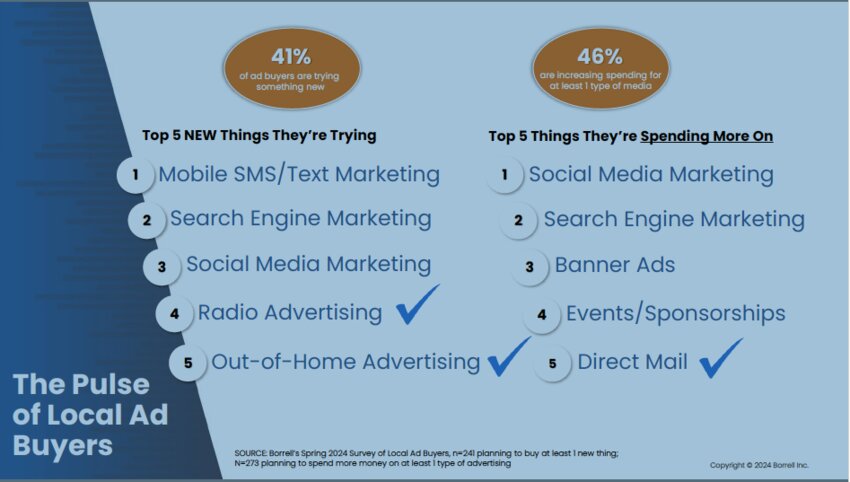
Another dynamic at play is that a new business and an existing local business may include traditional ad channels in their marketing plan and budget. However, their likely first step is creating and managing a website and social media content.
“You would think a local broadcast TV company, or any local media company, would want their sales reps to be strategic in their discussions with their customers. Striking the right balance between digital and traditional advertising and advising customers on the different dynamics is another evolving skillset,” Albarella said.
How to stop the spiral
Other than training ad sales reps in digital advertising so they can present a comprehensive palette of options to local advertisers, there are two evolutionary steps broadcast TV and cable TV should consider.
Annotti envisions local broadcast and traditional newspapers forming more alliances. “There undoubtedly will be more consolidation, but the consolidation may be traditional broadcasters gobbling each other. Instead, broadcasters and newspapers, which are now mostly digital publications, could form local journalism organizations that distribute their product on a variety of screens to ensure they’re responding to this much more diverse audience of consumers.”
According to Borrell, the second step is “a different set of people with a different mindset on boards at the company. There are signs that someone who doesn’t have any TV experience but does have internet experience and entrepreneurial experience can become the CEO of a big television company. I hope to see more of that, more leadership that is not broadcast TV leadership, whose only strategy is to continue doing the same with some slight incremental change.”
 Bob Sillick has held many senior positions and served a myriad of clients during his 47 years in marketing and advertising. He has been a freelance/contract content researcher, writer, editor and manager since 2010. He can be reached at bobsillick@gmail.com.





Comments
No comments on this item Please log in to comment by clicking here